
KARACHI PROPERTY & INHERITANCE LAW
Inheritance Mutation in Karachi: Legal Heirs, Revenue Records and Title Checks
Transferring inherited property in Karachi involves more than submitting a mutation application. Families must establish the deceased owner’s actual property interest, identify all lawful heirs, verify the original title documents and determine which authority is responsible for recognising the transfer.
Whether the property is leasehold, society-managed, DHA property or recorded through a revenue authority, the correct legal procedure depends on its ownership history and applicable records.
Understanding Inheritance Mutation in Karachi
Inheritance mutation in Karachi is often misunderstood as the document that creates a person’s inheritance rights. In reality, succession and the record of property ownership involve related but different legal questions. A family’s claim may depend on the deceased owner’s title, the identities and lawful shares of heirs, the property’s tenure and the authority maintaining its record.
A person may inherit an interest under the applicable personal law even while revenue or administrative records still show the deceased. Conversely, an entry in a register is not necessarily conclusive proof that an applicant holds an unchallengeable title. Getting this distinction right can prevent years of property disputes.
Evergreen legal guidance; editorial update 18 November 2026. This is not a new November 2026 amendment or court ruling.
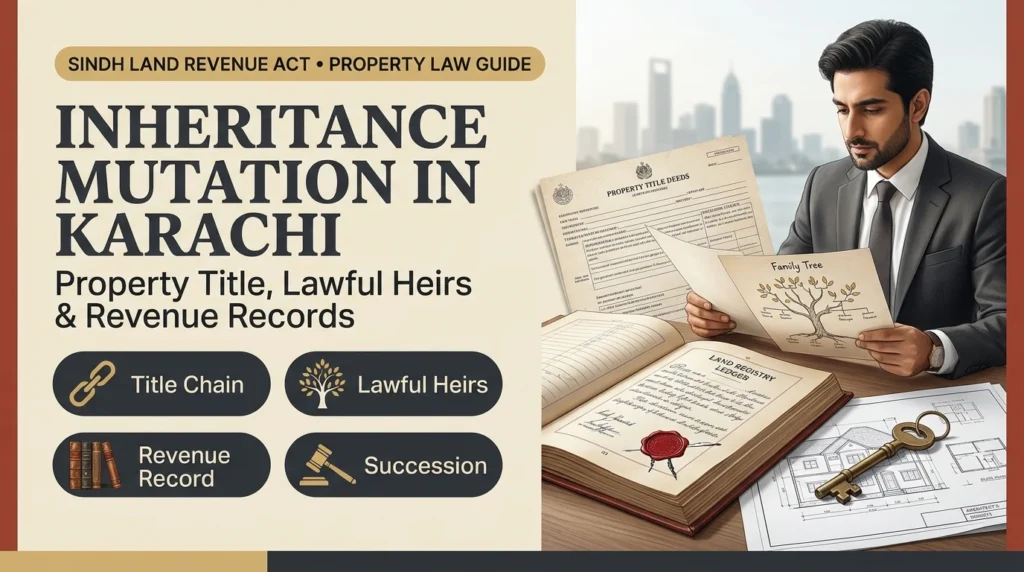
Inheritance Mutation in Karachi: What Changed and What Has Not?
The practical concern is that families increasingly encounter inconsistent names on CNICs, incomplete death records, old sale deeds and title held jointly with other people. These problems require documentary reconciliation, not a generic promise of instant online mutation.
The Sindh Land Revenue Act, 1967 establishes a statutory framework for certain land records. The Sindh Land Revenue (Amendment) Act, 2022 amended aspects of that framework; the official Sindh Code publication is dated 23 August 2022, not November 2026. Its section 52 treatment of the presumption relating to a revenue record should not be mistaken for a judicial declaration of indefeasible ownership.
Many urban Karachi properties do not follow exactly the same record procedure. DHA property, a cooperative society plot, leasehold property or another allotment may require the relevant lessor, society, development authority or land administration to recognise the transfer. The applicable legal route must be identified before preparing forms.
Identify the Nature and Location of the Property First
Ask for the original title chain: lease, registered sale deed, sub-lease, allotment letter, transfer letter, conveyance or earlier mutation record, as applicable. Then identify the record-keeping body. A legal heir should not file an agricultural-style revenue mutation request with a body that has no jurisdiction over a leasehold Karachi apartment.
The schedule should include:
The precise plot or property identifier.
Survey or record reference.
Property location and size.
Current owner shown in the relevant record.
Existing encumbrances and any disputed share.
If the property is jointly owned, determine what interest the deceased actually held. Death does not convert the shares of living co-owners into the deceased’s estate.
For title disputes and document checks, Qanoon Online’s Karachi property lawyer service provides a relevant point of reference for a formal review.
Establish the Complete List of Lawful Heirs
Family records can be a starting point but do not replace the legal task of determining heirs. Collect the death certificate, identity documents, marriage and family records and relevant birth certificates. Ask whether the deceased had a surviving spouse, parents, children or other relatives who may be entitled under the applicable personal law.
Do not assume that a NADRA Family Registration Certificate alone is a judicial decision determining ownership shares. Errors or omissions in an FRC should be documented and corrected through an appropriate process. A person excluded from a family record is not necessarily excluded from all substantive inheritance rights.
Where the estate is disputed or the personal law has special features, consult counsel about lawful shares and any probate or succession process. No universal percentages should be advertised without the actual family tree, religious/personal law and date of death.
Distinguish Succession Certificates From Land-Record Mutation
Under the applicable succession framework in Sindh, a Succession Certificate generally concerns movable property, while Letters of Administration concern immovable property. The Sindh Letters of Administration and Succession Certificates Act, 2021, including its subsequent amendments, should be consulted to determine the appropriate application and authority.
Mutation or transfer entry records a change in the land or other institutional register. One process cannot be assumed to substitute automatically for all the others. A bank may request different documents from a lease-granting authority, and a cooperative society may apply its own lawful transfer rules.
Before purchasing expensive “certificate packages,” ask the service provider exactly what document will issue, which authority issues it, what property it covers and whether its use is limited to a particular transaction.
Sindh Revenue Records and the Presumption of Correctness
Section 52 of the Sindh Land Revenue Act concerns entries in record-of-rights or annual records and a statutory presumption, subject to applicable law. A rebuttable presumption is not the same as a conclusive title judgment. Fraud, missing heirs, inaccurate boundaries or a flawed source transaction may require adjudication in the correct forum.
Revenue officers may carry out recording functions under the law, but they are not a substitute for a civil court deciding a serious contested ownership issue. The question is not simply whether an entry bears an official seal; it is whether the underlying transaction and inheritance entitlement are lawful and supported.
A lawyer should examine whether a challenged entry requires an administrative application, statutory appeal, review, civil suit or another proceeding. Forum and limitation questions are fact-specific and should be checked rather than guessed from an online checklist.
Inheritance Mutation in Karachi: Required Evidence
An initial evidence bundle can include:
The deceased person’s death certificate.
Copies of CNICs of all known heirs.
The deceased’s CNIC number.
Family-tree information.
Original or certified title documents.
Relevant municipal or society records.
Property tax information.
Previous ownership and transfer records.
Where names differ across a deed, CNIC and death certificate, compile a discrepancy table:
Document | Information to verify |
|---|---|
Title deed | Name, spelling and ownership interest |
CNIC | Correct identity details |
Death certificate | Deceased person’s recorded name and date |
Family records | Family relationships and missing entries |
Property record | Existing owner and property identifiers |
Do not edit scanned source documents to “make them match.” Request certified copies or an authorised record correction instead.
Retain the complete chronological title file. A current property search may not reveal a past mortgage, charge, trust issue or litigation. A transfer application submitted while another heir claims concealment can create serious difficulties later.
What If One Heir Refuses to Cooperate?
A family disagreement should not be resolved by omitting that heir from the application. The applicant must distinguish an absent heir, a genuinely disputed heir, a minor, an heir living overseas and a person who refuses to sign a particular transfer form.
An individual heir’s consent to one administrative step is not necessarily a lawful surrender of inheritance rights. For any release, gift, sale or family settlement, assess registration and other formal requirements. A coercive affidavit or unregistered transfer assertion may fail to achieve the intended result.
When a minor’s interest is involved, guardianship and property-disposal rules may require additional safeguards; no adult family member should assume authority to dispose of the minor’s share without examining the law.
Karachi Property Disputes: Notice, Objection and Civil Remedies
If a proposed mutation contains a wrong family tree or inflated share, act on documentary evidence rather than public accusations. Obtain the disputed application and entry, identify its statutory basis, preserve earlier records and promptly instruct a lawyer about an objection or challenge.
Where a civil declaration, injunction, partition or other ownership remedy is necessary, counsel should choose the appropriate cause of action and plead the complete chain of title. A strong legal claim is not created by inserting the word “fraud” into every objection. Particular allegations require particular proof.
The cross-network Karachi real-estate litigation and due-diligence service is relevant where a formal title investigation or property suit is contemplated. This is a contextual service link, not an assertion that every mutation issue requires litigation.
Protecting an Overseas Heir’s Interest
An heir residing abroad should verify the exact power-of-attorney requirements for the intended administrative or court action. Authentication, consular procedures and local authority acceptance may differ according to the jurisdiction and document purpose.
Avoid sending original documents or signing blank transfer papers at the request of an unknown intermediary. Request a draft of the application, the property’s complete identifiers and a written explanation of the proposed transfer before authorising an agent.
A lawyer can also advise whether a video call, identity verification, notarisation, attestation or apostille is necessary for the specific institution. An overseas heir should receive copies of every submitted instrument and official receipt.
Inheritance Mutation in Karachi: Practical Sequence
A practical approach to inherited property transfer involves the following stages:
- Identify the asset and relevant record authority. Establish whether the property is revenue land, leasehold, society property or another category.
- Verify the deceased owner’s actual share. Examine the complete title chain and establish what legally belonged to the deceased.
- Map all lawful heirs. Identify the family members who may be entitled and reconcile documentary inconsistencies.
- Obtain the required succession or administration documentation. Determine which document is legally appropriate for the asset and transaction.
- File the proper application. Submit the relevant documents and retain dated acknowledgments.
- Review the draft and final entry. Check every heir’s name and recorded share.
- Preserve the updated record. Keep it alongside the underlying title documents for future sales or disputes.
This sequence is guidance, not a promise that every Karachi property can be transferred in seven steps. Complex leases, missing owners, litigation and overlapping jurisdiction may require substantial additional work.
What If One Heir Refuses to Cooperate?
A family disagreement should not be resolved by omitting that heir from the application. The applicant must distinguish an absent heir, a genuinely disputed heir, a minor, an heir living overseas and a person who refuses to sign a particular transfer form.
An individual heir’s consent to one administrative step is not necessarily a lawful surrender of inheritance rights. For any release, gift, sale or family settlement, assess registration and other formal requirements. A coercive affidavit or unregistered transfer assertion may fail to achieve the intended result.
When a minor’s interest is involved, guardianship and property-disposal rules may require additional safeguards; no adult family member should assume authority to dispose of the minor’s share without examining the law.
Karachi Property Disputes: Notice, Objection and Civil Remedies
If a proposed mutation contains a wrong family tree or inflated share, act on documentary evidence rather than public accusations. Obtain the disputed application and entry, identify its statutory basis, preserve earlier records and promptly instruct a lawyer about an objection or challenge.
Where a civil declaration, injunction, partition or other ownership remedy is necessary, counsel should choose the appropriate cause of action and plead the complete chain of title. A strong legal claim is not created by inserting the word “fraud” into every objection. Particular allegations require particular proof.
The cross-network Karachi real-estate litigation and due-diligence service is relevant where a formal title investigation or property suit is contemplated. This is a contextual service link, not an assertion that every mutation issue requires litigation.
Protecting an Overseas Heir’s Interest
An heir residing abroad should verify the exact power-of-attorney requirements for the intended administrative or court action. Authentication, consular procedures and local authority acceptance may differ according to the jurisdiction and document purpose.
Avoid sending original documents or signing blank transfer papers at the request of an unknown intermediary. Request a draft of the application, the property’s complete identifiers and a written explanation of the proposed transfer before authorising an agent.
A lawyer can also advise whether a video call, identity verification, notarisation, attestation or apostille is necessary for the specific institution. An overseas heir should receive copies of every submitted instrument and official receipt.
Legal References and Further Reading
The following sources provide the statutory and institutional background relevant to this guide:
- Sindh Land Revenue Act, 1967 – Government of Sindh reading copy
- Sindh Land Revenue (Amendment) Act, 2022 – Official Sindh Code
- Sindh Letters of Administration and Succession Certificates Act, 2021 – Official Sindh Code
- NADRA – Succession Certificate and Letters of Administration
- Sindh High Court – Official Case Law Portal
Editorial last updated: 18 November 2026. Informational guidance only; no transfer, tax result or court outcome is guaranteed.
Legal verification note: The Forest Department reading copy of the 1967 Act identifies its consolidation as updated through the 2013 amendment. Do not treat that copy alone as the complete current amended statute. Use the official Sindh Code and applicable subsequent amendments for final statutory verification.
Frequently Asked Questions About Inheritance Mutation
1. Does mutation itself make someone a legal heir?
No. Inheritance rights are determined by applicable substantive law; mutation records the asserted change in the relevant register.
2. Is every Karachi property governed by the same mutation office?
No. The institution depends on the property's tenure, location and original issuing authority.
3. Is a Family Registration Certificate sufficient proof of inheritance?
It may help identify family relationships but does not itself settle every question of title, entitlement or disputed heirs.
4. Can an heir be left out because they live abroad?
No. Physical absence does not by itself extinguish lawful inheritance rights.
5. Does a revenue entry conclusively establish ownership?
Not necessarily. Its legal effect and presumption are subject to the statute and may be challenged in appropriate proceedings.
6. What if the deceased owned only a partial share?
The estate ordinarily concerns the deceased's lawful interest, not every co-owner's property.
7. Can one heir transfer a minor's share without review?
Do not assume so. Special legal safeguards and authorisation may apply to a minor's property.
8. What if the title deed and CNIC have different spellings?
Document the discrepancy and seek a lawful correction or supporting evidence instead of altering an original document.
9. Must every disputed mutation go to civil court?
Not always. The correct remedy and forum depend on the nature of the objection, applicable statute and ownership issue.
10. How should the family prepare for legal advice?
Bring the death and family records, complete title chain, property identifiers, any disputed entry and a list of all known heirs.
Protect Your Inheritance Rights Before Transferring Property
Inheritance mutation in Karachi should begin with a clear understanding of the deceased owner’s property interest, the complete list of lawful heirs and the authority responsible for maintaining the property record.
An incorrect family record, incomplete title chain or improperly handled transfer application can create difficulties for heirs and future property transactions.
Before proceeding, arrange a review of the relevant documents and establish the appropriate legal procedure for your property.