
EXPERT LAWYERS FOR SUCCESSION CERTIFICATE/ADMINISTRATION LETTER IN KARACHI & ISLAMABAD
Succession Certificate Professional Services in Islamabad & Karachi
Obtaining lawful authority over a deceased family member’s assets requires strict adherence to legal and regulatory procedures. Whether you’re navigating NADRA’s biometric facilitation process or filing an application in the civil courts in Islamabad, our senior legal practitioners provide structured legal counsel, document verification, and direct representation to streamline asset transmission for legal heirs.
Comprehensive Asset Coverage: Legal support for both movable assets (bank accounts, shares, savings certificates) and immovable property (residential and commercial real estate).
Court & NADRA Representation: Complete handling of administrative checks, public notice publications, objection filings, and civil court proceedings.
Overseas Pakistani Facilitation: End-to-end legal support for legal heirs abroad, including drafting a Special Power of Attorney (POA) and guidance on consular attestation.
Need Immediate Assistance with a Succession Matter?
Speak Directly with Our Legal Team in Islamabad:
Book an Appointment in Islamabad: +92 333 1127836
Application Preparation | NADRA Verification | Family Court Representation
 Book an Appointment in Islamabad: +92 333 1127836
Succession Certificate or Letter of Administration?
In Pakistan, a Succession Certificate covers a deceased person’s movable assets, such as bank balances and securities. A Letter of Administration concerns immovable property, such as a house or plot. The correct application depends on the assets, the legal heirs and the law applicable in the relevant province or Islamabad Capital Territory.
The National Database and Registration Authority (NADRA) provides a facilitation process for eligible applications through designated facilities. Where a dispute or another legal impediment arises, the matter may require a competent court. The route is not identical throughout Pakistan.
The public-notice stage includes a 14-day objection period; it is not a promise that the entire application will finish in 14 days. Document checks, verification of all heirs, biometrics and any objections affect completion. Overseas heirs should confirm the currently available verification arrangements with NADRA or the relevant Pakistan Mission before making travel plans.

Calculate Your Islamic Inheritance Share
Find out how an estate may be divided among legal heirs under Hanafi Sunni rules.
To apply for a Letter of Administration/Succession Certificate, follow these steps:
1. Application submission
Identify the appropriate NADRA facility and jurisdiction, complete the prescribed application and obtain the required authorization from the other legal heirs. Prepare the deceased’s death certificate, CNIC cancellation certificate, Family Registration Certificate (FRC), heirs’ identity documents and asset details. Requirements for representation and additional documents depend on the applicable law.
2. Legal heirs and assets
Disclose all legal heirs and the assets for which the document is sought. Check names, identity numbers and family records before filing. A bank balance or security and an immovable property require the appropriate type of succession document; a family record alone is not a substitute for the application.
3. Verification of legal heirs
NADRA checks the family and identity information. The prescribed biometric verification must also be completed by the heirs through the applicable facilities. If records are inconsistent or verification cannot be completed, seek instructions for resolving the issue rather than assuming that an affidavit will always replace biometrics.
4. Public notice and objections
Public notice allows competing claims or objections to be raised. Under the ICT procedure, the notice is published on the Authority’s portal and in an English and an Urdu daily newspaper of wide circulation. The applicable provincial procedure should be checked for applications elsewhere.
5. Issuance of the succession document
After the objection period and required verification, an eligible uncontested application can proceed to issuance. The document identifies the legal heirs and their respective shares under the applicable personal law. The 14-day notice period is one stage of the process, not a guaranteed delivery date.
NADRA’s official succession guidance
Check NADRA’s succession certificate requirements and its succession service portal for the current application facilities and instructions. Confirm the correct submission channel before sending documents; do not assume every NADRA office accepts succession applications or that the entire process can be completed online.
The applicable personal law determines who inherits and each heir’s share. A succession document does not replace every bank, land-record or registration formality, and it is not a general mortgage or ownership guarantee. A will, an omitted heir or a disputed asset requires examination on the facts.
Our legal team can review the proposed application and identify missing records before submission. Official processing charges and professional fees should be explained separately.
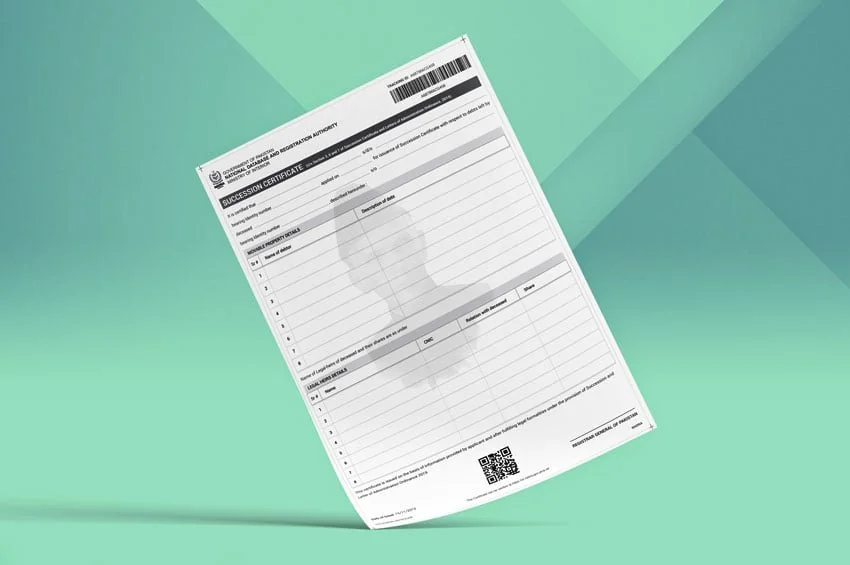
Succession Certificate Fees
NADRA processing fee
The official NADRA fee schedule, checked on 17 October 2026, lists:
- Assets worth Rs. 100,000 or more: Rs. 20,000 for a new application; Rs. 22,000 in Sindh.
- Assets worth less than Rs. 100,000: Rs. 10,000 for a new application.
- Duplicate application: Rs. 5,000.
Confirm the applicable official charges before filing. These amounts are not a total legal-service quotation. Professional fees and any separately applicable expenses depend on the work required and should be agreed in advance. Court matters may involve different charges.
What the certificate enables
A succession certificate provides authority relating to the specified movable estate, including relevant debts and securities. A Letter of Administration concerns immovable property. After issuance, the relevant bank, institution or land-record office may still require its own transfer or release formalities. The application must accurately identify the estate and heirs; the certificate does not automatically approve borrowing or a mortgage.
A Succession Certificate can be obtained by providing the following information:
- The deceased person’s death certificate and NADRA CNIC cancellation certificate.
- The Family Registration Certificate (FRC), with family-record discrepancies addressed as required.
- A complete list of legal heirs and copies of their identity documents, together with the applicant’s identification and contact details.
- Details of the relevant movable assets or immovable properties, supported by the available bank, investment or property records.
- The prescribed authorization or affidavit, including Oath Commissioner attestation where required.
- Additional representation, minor-heir or guardianship documents where the applicable law requires them.
Check that names and identity numbers match across the documents. The Letter of Administration or Succession Certificate being requested is not itself a prerequisite document for the initial application. Bring the available originals and copies to the document-review appointment so that any missing item can be identified.
Who can apply, and when is a court case needed?
The applicant must have the standing required by the applicable law and disclose every legal heir. A spouse, child or parent may be an heir depending on the family circumstances and personal law. Adoption or an informal family arrangement should not be treated as automatically establishing inheritance rights.
Provincial distinctions
Islamabad Capital Territory: the federal Letters of Administration and Succession Certificates Act 2020 applies to ICT. Its NADRA process includes a mechanism for declining matters requiring adjudication, with court jurisdiction governed by that Act.
Punjab: the 2025 amendment expressly permits issuance by NADRA or a civil court. A civil court follows the Succession Act 1925, and the former section 10 bar has been omitted. A blanket statement that every Punjab court application first requires a NADRA decline is therefore inappropriate.
Sindh: the 2025 amendment removes minority alone from the definition of controversy and provides for juvenile identity cards or child registration certificates. It also requires court-appointed guardianship before execution in relation to the affected minor or mentally disabled heir’s assets and share. Representation and supporting documents must follow the amended law.
Khyber Pakhtunkhwa and other jurisdictions: separate provincial legislation and procedures apply. Sindh’s amended treatment of minor heirs must not be assumed to apply throughout Pakistan.
Contested cases and court procedure
A dispute over an heir, entitlement, assets or the authenticity of documents may require judicial determination. The appropriate court route, any required NADRA decline, the petition, notices and supporting evidence depend on the jurisdiction and nature of the dispute. Contested proceedings have their own timetable; no fixed completion date can be guaranteed. Where inherited immovable property is disputed, our property dispute and transfer lawyers in Karachi can assess the related property issue.
Documents and verification before issuance
Before issuance, check the application against the deceased’s identity and death records, the heirs’ identification, the required authorizations and the schedule of assets. Keep the application reference and official payment receipts. Resolve any inconsistency or objection through the prescribed process.
Public notice must be given as required by the applicable law. For ICT, section 6 requires publication on the Authority’s portal and in an English and an Urdu daily newspaper. Completion of the objection period does not dispense with biometric and other verification requirements. The document records the heirs and their respective shares under the applicable personal law.
Legal assistance from Qanoon Online
Our legal team assists with checking heirs and assets, preparing documents and authorizations, coordinating the application and representing clients where court proceedings are needed. The relevant authority or court issues the succession document; a law firm does not issue NADRA certificates.
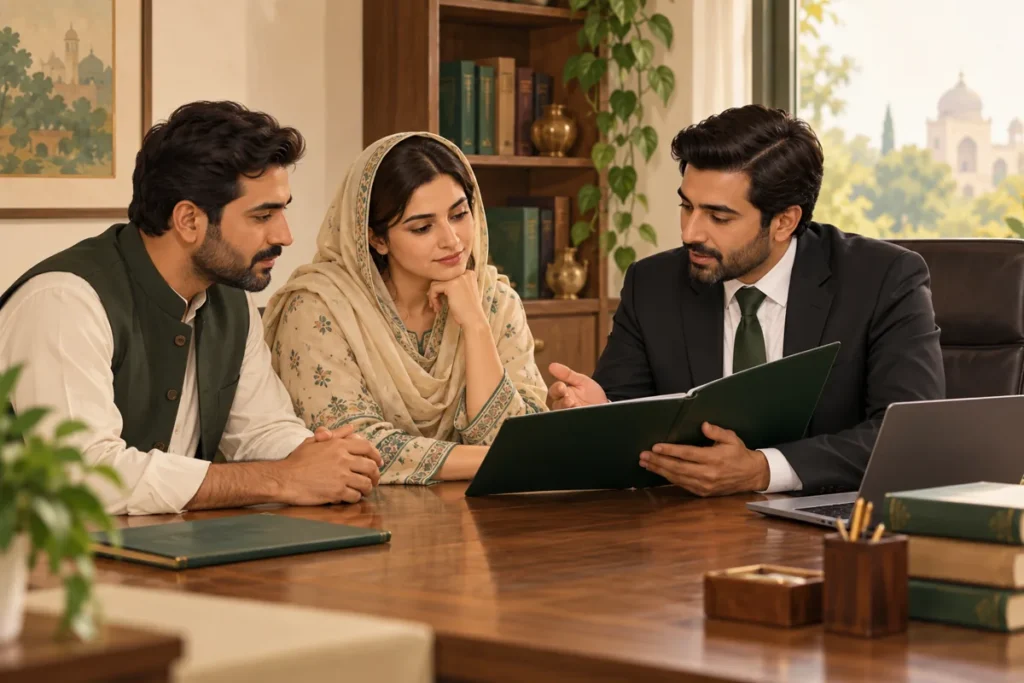
For an appointment, bring the death and identity records, available family documents and a list of the assets. Tell the lawyer about any minor heir, overseas heir, objection, missing record or previous application. This helps establish the appropriate route and the work involved.
Karachi appointments: call +92 331 6644789. Head Office: 2nd Floor, Supreme Corner, Johar Chowrangi, Gulistan-e-Johar, Karachi. DHA office: 76-C, Mezzanine, Main Jami Commercial, Phase 7, DHA, Karachi. Please confirm your appointment location when calling.
Frequently Asked Questions (FAQs)
1. Do I need a lawyer for a Succession Certificate?
The need for representation depends on the jurisdiction and the circumstances. Legal assistance is particularly useful where records conflict, an heir is overseas, a minor’s interests are involved or a dispute requires court proceedings. Ask what work the lawyer will undertake; the issuing authority or court makes the decision.
2. Which documents should I bring to an appointment?
Bring the death certificate, CNIC cancellation certificate, FRC, heirs’ identity documents, available asset records and any existing application or objection. The lawyer can then identify the prescribed authorization and any additional documents needed for your jurisdiction.
3. Does a Succession Certificate cover a house or plot?
A Succession Certificate concerns movable assets such as bank balances and securities. A Letter of Administration concerns immovable property. Where an estate contains both types of assets, check which applications and subsequent transfer formalities are required.
4. How much does a Succession Certificate lawyer in Karachi charge?
Professional fees depend on the documents, representation and court work required. Request a quotation that separates the lawyer’s fee from NADRA charges and other expenses. The official processing figures above are not a complete quotation for legal services.
5. Can an overseas heir complete verification abroad?
NADRA provides overseas biometric verification arrangements for succession matters. Confirm the current facility and procedure with NADRA or the relevant Pakistan Mission for the heir’s location. Authorization, identity and asset documents still need to satisfy the applicable requirements; availability should be confirmed before travel.
6. Can I hire a lawyer from another province?
Discuss the jurisdiction, the lawyer’s ability to act in the relevant forum and any local representation needed. Punjab, Sindh, KP and ICT do not have identical succession procedures. The location of the deceased and the assets can affect where and how the application proceeds.
7. Will the certificate be issued within 14 days?
The 14-day period relates to objections after public notice. It is not a guaranteed total processing time. Document checks, biometrics, record corrections and objections can affect issuance, while a contested court case follows its own timetable.
8. What happens if someone objects or an heir is missing from the records?
Raise the issue before proceeding on an incomplete or disputed heir list. NADRA may need corrected records or may decline a matter requiring adjudication under the applicable law. A lawyer can assess the competent court route and the evidence required; heirs should not be omitted simply to speed up the process.